commercial tier build · reviewed July 2026
Commercial Golf Simulator Cost: $45,000+ Per Bay
Multi-bay commercial builds run $45,000-$90,000 per bay depending on finish level and licensing. Here's what actually drives that range.
- $13,995 Buy
Launch monitor
Trackman iO - $6,999 Buy
Launch monitor
Foresight Sports GC3 - $1,799.99 Buy
Enclosure
SIGPRO / Indoor Golf Shop SIG8 - $2,899 Buy
Projector
BenQ AK700ST - $300 Buy
Software
TruGolf E6 Connect
As an Amazon Associate and affiliate partner, CaddieBay earns from qualifying purchases.
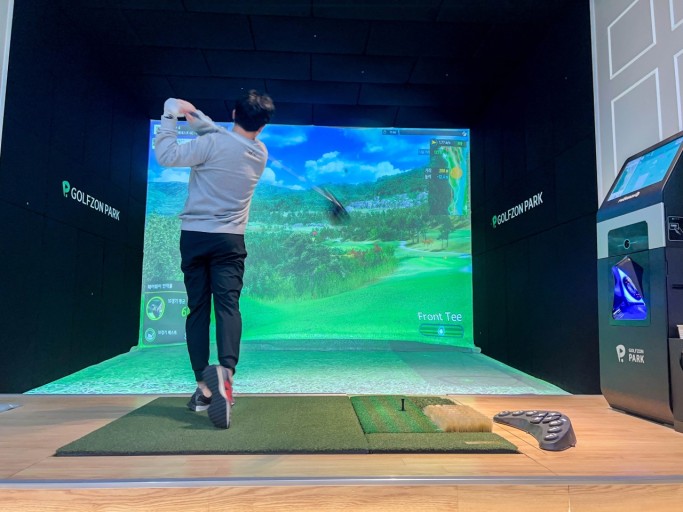
Commercial and multi-bay builds, golf entertainment venues, teaching studios, country club practice facilities, run $45,000 to $90,000-plus per bay depending on finish level and software licensing tier, according to current published estimates for Trackman-based commercial installs. Other published estimates land in a wider band, GOLFZON has cited total installation costs from roughly $22,000 to $85,000 depending on vendor and finish choices, which is a reminder that “per bay” numbers move a lot depending on whether they include construction, furniture, and licensing or just the hardware. Zoom out to the whole venue and the range widens further: a small 2-to-3-bay entertainment concept can launch for $55,000 to $230,000 all-in, while a larger facility built around a full bar and social space runs $350,000 to $700,000-plus.
What actually drives the range
The launch monitor itself, Trackman iO or Foresight GC3/GCQuad at commercial licensing rates, is one line item among several, and often not the biggest one once construction is counted. Published cost breakdowns for commercial installs consistently name the same drivers stacking on top of the hardware: a brighter, more durable projector rated for higher-traffic use than a home short-throw unit; an enclosure and impact screen built for constant, unsupervised public use rather than a household’s occasional swings; and then the build-out itself, flooring, electrical work, lighting, sound treatment, networking, HVAC sized for multiple bays running simultaneously, signage, furniture, a reception area, and whatever local code requires for a public-facing commercial space. None of that shows up in a home-bay parts list, and together it can outweigh the launch monitor’s price.
Software licensing is where commercial and personal use diverge hardest. Trackman’s iO software runs roughly $700 a year for a Home-tier license, but a Home Complete or Commercial license, the tier actually required to operate a paying bay, runs closer to $1,100 a year per bay, with the first year usually bundled into the purchase. On top of that, Trackman’s Portal booking-and-payments layer costs $25 a month (or $250 a year) per bay, and an optional hardware protection plan, which gets you a loaner unit while a damaged sensor is repaired, runs another $1,000 a year. None of those are optional in practice for a venue that can’t afford a bay sitting dark during a hardware issue.
Foresight versus Trackman for a commercial build
Both brands run successful commercial installations, and the hardware price gap between them is real and worth pricing out before committing to a fleet of bays. Trackman iO’s standalone hardware starts around $13,995, but that figure excludes the enclosure, screen, projector, mat, gaming PC, and installation, bundled packages through authorized retailers that include all of it typically run $20,000 to $30,000 per bay, and a full room-prep install, electrical, ceiling reinforcement, acoustic treatment, professional labor, brings a working iO room to roughly $25,000 to $28,000 before annual licensing even starts.
Foresight’s GCQuad, the commercial-grade step up from the home-tier GC3, prices closer to $14,000 to $15,999 for a full-featured base package with clubhead measurement included, with a putting-analysis add-on running another $2,500. That’s a meaningful discount against Trackman’s bundled hardware cost, and it compounds across a multi-bay build: license fees apply per launch monitor, so every bay you add carries its own annual software cost regardless of brand, which means the hardware-price gap between Foresight and Trackman multiplies rather than staying fixed as a venue scales past two or three bays.
Trackman’s name recognition among golfers shopping for simulator time carries real marketing value in a commercial context that it doesn’t carry in a private home; customers book Trackman by name the way they’d book a specific gym franchise. Foresight’s lower per-bay hardware cost lets an operator open more bays, or bank more margin, for the same total capital. That’s the actual tradeoff: brand pull that shows up in bookings versus unit economics that show up in the P&L, and there’s no universally correct answer, it depends on the venue’s concept and target customer.
Before committing capital
This tier is where “get a real quote from an installer” replaces “price it yourself.” The variables, square footage, number of bays, local electrical and construction code, HVAC capacity, software licensing terms, are specific enough to your location and business plan that a parts-list estimate stops being useful past this point.
A few commercial-specific questions are worth putting to any installer or vendor before signing anything, since they’re the ones a home-bay build never has to answer. Does the software license cover unattended public use, or does the vendor’s terms of service restrict the personal-use tier to a private residence, a real distinction Trackman and Foresight both enforce contractually, not just informally? Does the hardware warranty hold up under materially higher shot volume than a household ever generates, and is there a loaner or protection plan (Trackman’s runs $1,000 a year per bay) so a sensor failure doesn’t take a bay fully offline for weeks? And does the enclosure and screen carry a duty rating for constant public use rather than a home-bay’s occasional-golfer expectation, since the impact surfaces absorbing thousands of paying customers’ swings a month wear on a completely different timeline than a garage bay used a few times a week.