Projector · priced July 17, 2026
Optoma GT2100HDR Cost: Under $1,500 Short Throw
The GT2100HDR sells for around $1,499 and offers the shortest throw distance in its class, a real advantage in tight garage bays.
- Around $1,499 street as of July 2026
- Shortest throw ratio in its class (fits tight bays)
- 1080p resolution
- HDR support
Via Amazon. As an Amazon Associate and affiliate partner, CaddieBay earns from qualifying purchases.
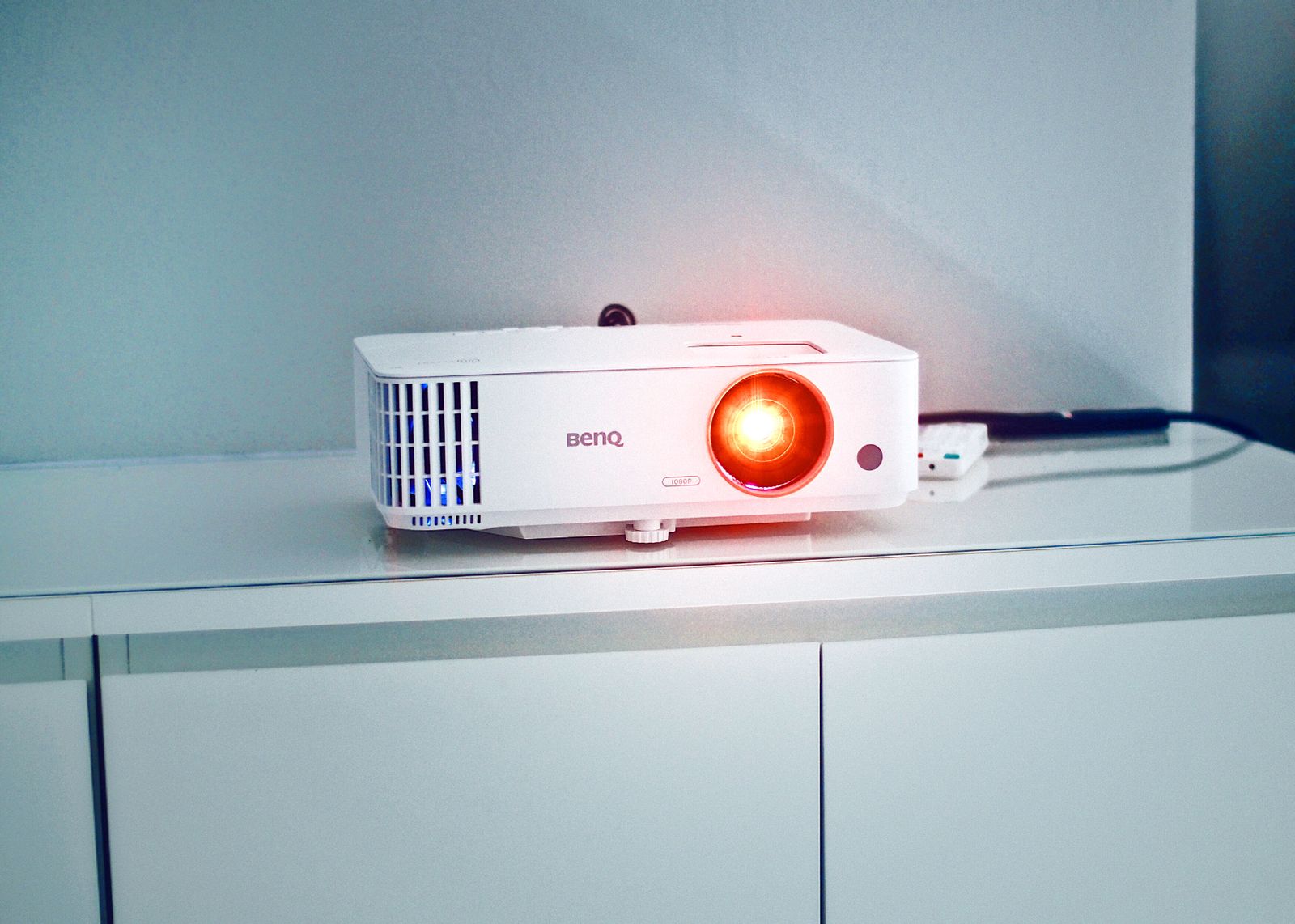
Throw ratio, how much screen a projector fills relative to its distance from that screen, is the number that actually matters for a garage build, more than resolution or brightness in isolation.
Get it wrong and you’re stuck with a small image or a projector mounted somewhere impractical, since most garage bays don’t have the 15-plus feet of ceiling-mount distance behind the hitting position that a long-throw model needs.

The specs beyond throw ratio
The GT2100HDR is 1080p, not 4K, and that’s the real tradeoff behind the price. Optoma’s own spec sheet lists 4,200 lumens, a 300,000:1 native contrast ratio (2,000,000:1 dynamic), and HDR10 and HLG input support. That HDR badge only does something if the source feeding it is actually outputting HDR, and most simulator software renders in standard color, so it matters more for movie night in the same bay than for an actual round of golf. The laser light engine is rated for 30,000 hours, which at three to four hours of daily use works out to 20-plus years before brightness degrades below usable levels, meaning there’s no bulb to ever budget for over the life of a build, a real advantage over the lamp-based projectors this class used to be built around.
Throw ratio is where the GT2100HDR actually separates itself, and it’s worth putting the exact number on it rather than the vague “shortest in its class” framing alone. Optoma rates it at 0.496:1, meaning a 100-inch image needs the lens only about 4 feet 4 inches from the screen, and a 120-inch image needs roughly 5 feet 3 inches, per Optoma’s own projection calculator. For comparison, the BenQ AK700ST, the mid-tier pick in this guide, carries a 0.69-0.83:1 throw ratio, needing 30 to 50 percent more distance to fill the same screen. In a garage bay where the tee sits 8 to 10 feet from the impact screen, that gap decides whether the projector mounts on the ceiling directly above the golfer’s head or gets pushed back far enough to intrude into the next bay over.
The Optoma GT2100HDR carries the tightest throw ratio in its price class, letting it mount closer to the screen than most competitors while still filling the same hitting area.
Input lag and connectivity
Input lag is the other number worth checking before buying any projector for a sim bay, and here the GT2100HDR does well: Optoma’s own gaming-mode figure is 8.6 milliseconds at 1080p and 120Hz. That number has nothing to do with launch-monitor tracking accuracy, the camera or radar unit captures the shot independently of what’s on screen, but it does affect how quickly the ball flight and swing overlay actually appear after impact, which is part of what makes a simulator feel responsive rather than laggy. Connectivity is basic but sufficient for the job: dual HDMI 2.0 inputs, a 3.5mm audio out, USB-A for accessory power, plus RS232 and RJ45 for the kind of remote control a commercial or multi-bay install would want. There’s no USB-C and no built-in streaming apps here. This is a projector built to be fed by a sim PC, not to run anything on its own.
At around $1,499, it’s the budget-tier pick for anyone whose bay doesn’t have generous ceiling-mount depth behind the tee position.
What it costs in 2026, and when to skip it
Price has moved around over the course of 2026. Optoma lists an MSRP near $1,799, third-party Amazon listings have dipped as low as roughly $1,075, and Amazon’s own direct listing has floated in the $1,400-$1,500 range depending on the week. Shop around rather than trusting a single retailer’s sticker price, but even at the higher end of that range it’s still the cheapest way into a laser short-throw projector with a sub-0.5 throw ratio.
For a tight garage bay with limited ceiling-mount depth behind the tee, that combination of throw ratio and price is hard to beat in this category. The case for skipping it: anyone who specifically wants 4K resolution, a motorized zoom lens for mounting flexibility, or BenQ’s Auto Screen Fit and dedicated Golf Mode calibration should look at the AK700ST instead, at roughly double the cost. The GT2100HDR isn’t trying to be that projector. It’s trying to be the one that fits a bay nothing else fits, at around $1,499.