Launch monitor · priced July 12, 2026
Trackman Cost: iO $13,995, Trackman 4 $21,495+
A Trackman iO unit alone is $13,995. Full home builds run $25,000-$35,000 all-in. Here's the real all-in number before you fall for the launch-monitor sticker price.
- Dual radar + high-speed camera (OERT), 40+ ball and club data parameters
- iO unit: $13,995; full home build: $25,000-$35,000 all-in
- Trackman 4 unit: $21,495-$24,950; full build: $35,000-$55,000+
- TPS subscription: $700/yr (Home, ball data) to $1,100/yr (Home Complete, full club data)
Via Indoor Golf Shop. As an Amazon Associate and affiliate partner, CaddieBay earns from qualifying purchases.
Trackman is the launch monitor every broadcast golf viewer has already seen, even if they don’t know the brand name: it’s the radar-and-camera system behind the ball-flight graphics on PGA Tour telecasts. That pedigree is real, and it’s also the reason Trackman commands a price multiple no competitor gets away with.
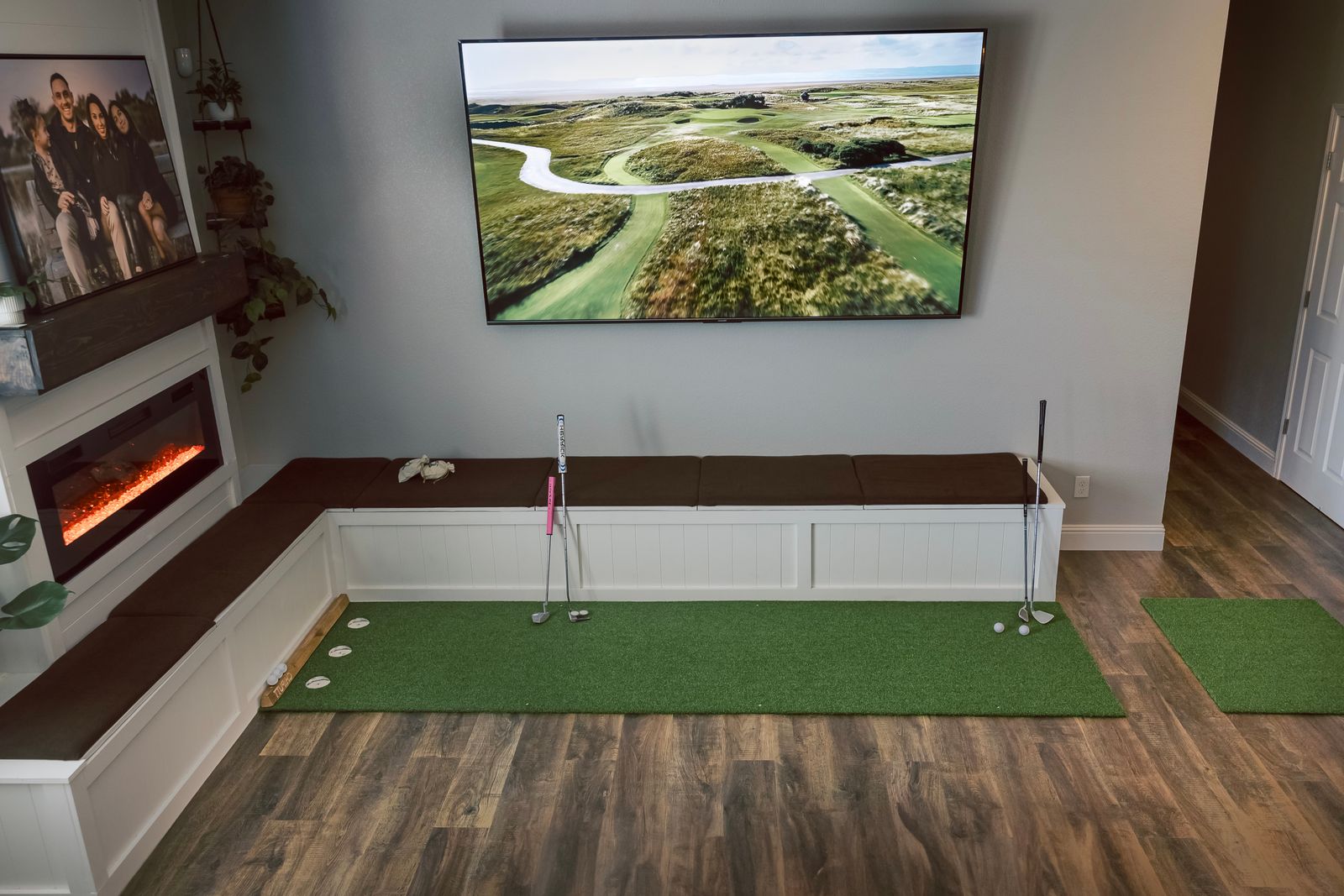
The iO unit alone is $13,995. A complete home build, enclosure, impact screen, projector, hitting mat, PC, and installation, runs $25,000-$35,000 all-in. Step up to a Trackman 4 unit ($21,495-$24,950) and the full build climbs to $35,000-$55,000-plus. Layer a Trackman Performance Studio (TPS) subscription on top of either: $700/year for the entry Home tier, which covers ball data and the standard course library, or $1,100/year for Home Complete, the tier that actually unlocks full club data, face angle, angle of attack, dynamic loft, plus the larger 400-plus-course Virtual Golf library. Most buyers land on the $1,100 figure because Home alone leaves the club-data half of the pitch locked behind a second purchase.
What the ceiling-mounted radar is actually doing
Trackman iO is a fixed, ceiling-mounted unit, not a tripod puck you carry between bays or take to the range. That’s a deliberate tradeoff: give up portability, get a sensor with a permanent, calibrated sightline to the whole hitting area. It reads more than 40 ball and club data parameters using what Trackman calls Optically Enhanced Radar Tracking (OERT), dual Doppler radar synchronized with a high-speed camera. The radar tracks ball and club continuously through impact; the camera locks the exact impact location on the clubface and precise ball position without alignment stickers or tape markers, the workaround most camera-only systems still lean on.
The claim that actually matters for accuracy is what the indoor model is built on. A camera-only unit captures a fraction of a second at impact and extrapolates the rest of the flight from an algorithm. Trackman’s indoor predictions are checked against the same reference dataset as the outdoor Trackman 4: billions of measured full ball flights recorded on ranges and at tour events over two decades, not a synthetic model built from impact data alone. Spin specifically is measured directly at impact rather than calculated backward from carry distance, which is where radar-only indoor units tend to drift in a short-ceiling garage bay.
The honest comparison
A Foresight GC3 at $6,999, no subscription, gets a serious home builder most of the way to Trackman’s data quality for a fraction of the total cost, roughly 2 to 5 times less depending on which Trackman tier you’re pricing against. The accuracy gap that remains matters most to players chasing tour-level precision or coaches building a commercial teaching bay, less to someone who wants an honest number on carry distance and shot shape in their garage. Worth weighing against the sticker-price gap: the GC3 includes full club data with zero subscription required, while Trackman gates that same club data behind the $1,100/year Home Complete tier.
The tour pedigree behind the price
Trackman’s premium isn’t just brand recognition. It’s the radar system the PGA Tour has run as the backbone of ShotLink for more than two decades, recently renewed through 2030 across 36 radar units. The DP World Tour named Trackman its official launch monitor and ball-tracing technology in a 2025 agreement. The LPGA Tour began a Trackman-centered broadcast partnership in 2026. LIV Golf runs Trackman radar on all 18 tee boxes at every global event. The R&A has independently validated the technology through its own accuracy assessments. Buying an iO buys the same measurement system those tours use for official statistics, ceiling-mounted at home instead of tee-box-mounted at a broadcast event, not a consumer approximation built to resemble it.
Who this tier is actually for
Commercial installations, teaching studios, and buyers for whom the Trackman name itself carries value, resale, prestige, matching a facility’s existing fleet, are the real audience. If your bay is a personal garage build and the goal is accurate practice, this is spending five figures more than the data quality alone justifies.
The teaching-studio case is different: a coach billing hourly against a facility fleet of matching hardware recoups the premium in ways a solo garage build never will.